

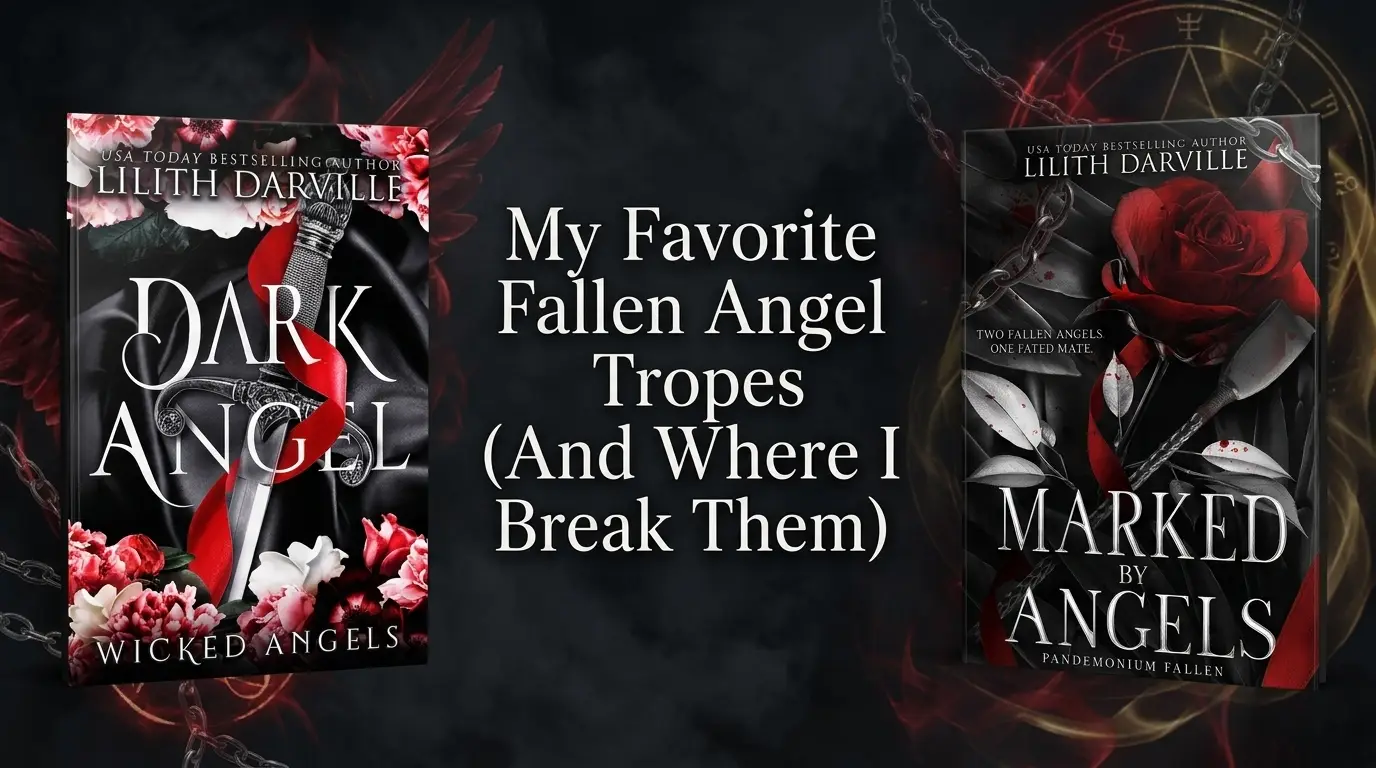
If you love fallen angel romance tropes, welcome to one of my favorite dark little playgrounds. Fallen angels give me everything I want as a writer: power, ruin, obsession, hunger, guilt, devotion, and the question that always gets me—what happens when something made for heaven wants something it was never supposed to touch?
But I don’t love tropes because they’re tidy. I love them because they let me promise you a fantasy, then push harder on the emotional cost, the consent, the damage, and the healing. So yes, I absolutely play with the tropes readers come for in fallen angel romance, but I also like twisting them until they feel rawer, riskier, and more personal.
Why Fallen Angels Hit So Hard
Fallen angels are already carrying the wound before the romance even begins. They come built with exile, punishment, moral fracture, divine shame, and that gorgeous tension between what they were created to be and what they’ve become.
That means the love story never starts on neutral ground. It starts with a man who may see himself as dangerous, damned, or beyond saving, and a heroine who has to decide whether she’s walking into destruction, redemption, or both.
Fated Mates, But Meaner
I enjoy fated-mate energy most when it doesn’t feel easy or comforting at first. In MARKED BY ANGELS, the bond arrives through blood, violence, supernatural danger, and a heroine who survives what should have destroyed her, which makes the connection feel less like a soft cosmic gift and more like destiny kicking the door in.
That’s where I tend to break the trope a little. I’m less interested in “the universe chose you, so relax into it” and more interested in “the universe chose you, now what the hell are you going to do about it?” Evie isn’t there to melt because fate said so; she questions, resists, negotiates, and has to emotionally choose the bond rather than simply submit to it.
Touch-Her-And-Die
This one is catnip for me when it’s earned. In MARKED BY ANGELS, Kael’s reaction to danger is not subtle, and the energy around protecting Evie is absolutely feral. He literally meets the threat with a version of “touch her and die,” and because his history is soaked in loss and curse, it lands as more than macho posturing.
That’s also where I like to bend the trope. Protective obsession only works for me if the heroine still has her own agency, her own fire, and her own choices, so the fantasy is not “woman as possession” but “woman so significant she changes the emotional and supernatural rules around her.”
Redemption With Teeth
Redemption is one of the deepest roots in my work. In DARK ANGEL, Jaden is not a polished, morally uncomplicated hero waiting to be understood. He is already carrying rage, grief, violence, and a mission shaped by trauma, and that makes the romantic payoff matter more because love is not decorating a good man—it is confronting a broken one and asking whether he can still choose something better.
This is one place I deliberately break reader comfort a little. I don’t write redemption as instant softness or easy absolution; I write it as friction, relapse, resistance, honesty, and the long emotional labor of becoming worthy of what you want. That’s also true in the wider fallen-angel space of MARKED BY ANGELS, where curse, guilt, and hunger are not erased by desire alone.
The Branded Heroine
I love a branded heroine trope when the mark means more than ownership. In MARKED BY ANGELS, Evie’s mark is supernatural, intimate, dangerous, and impossible to ignore, but it also becomes a sign of transformation, perception, power, and belonging.
That difference matters to me. I’m not interested in a heroine being stamped and reduced; I’m interested in what happens when a mark reveals who she already is, awakens what was dormant, and turns her into someone the world can no longer dismiss.
Where I Push The Trope
Some fallen angel romance leans into the hero as the entire event. I get the appeal, obviously, but I’m always going to care just as much about the heroine’s fracture line, her hunger, her refusal, and the particular shape of her healing.
That’s why my versions of these tropes usually come with a few built-in complications:
- The heroine is not a passive recipient of destiny, power, or desire.
- The angel is not automatically right just because he is ancient, obsessed, or suffering.
- The bond may be fated, but the emotional surrender still has to be chosen.
- Protection gets hotter when it collides with respect, consent, and real emotional stakes.
- Redemption means more when it costs something.
That last one may be the biggest divider between “nice trope” and “Lilith trope.” I want the fantasy, yes, but I also want the bruise under it.
If These Are Your Catnip Tropes
If your favorite fallen angel romance tropes include fated bonds, possessive protectiveness, damaged immortals, branded heroines, and men who need redemption almost as badly as they need the heroine, you’re very much in my corner of the bookshelf. DARK ANGEL gives you that wounded, dangerous, morally sharp edge through Jaden and Rayne, while MARKED BY ANGELS pushes deeper into curse, blood-bonding, possessive intensity, and supernatural claiming with Evie, Kael, and Thane.
And honestly, I’ll probably keep breaking these tropes as long as I keep writing them. Not because I don’t love them, but because I do. I just want them messier, hotter, more emotional, and a little more dangerous than they were when they walked in.
Keep reading and feeding your fantasies! ❤️🔥